




When a mother convinces a father to abandon his seven-year-old twins, when a child comes home to find a stranger is now “your new dad,” when decades later that child becomes the attorney representing other children in custody cases – what does he learn about alienation, survival, and the long-term effects that shape an entire life?
There’s a magazine article that Steven Eichenblatt found many years after his biological father had passed away. His father had written it – a personal essay about the last night he spent with his children before he disappeared from their lives.
In it, his father described going to a psychiatrist for advice about his impending divorce and custody situation. The psychiatrist’s recommendation was simple and devastating:
“Just pretend they are dead.”
So that’s what he did. He dropped seven-year-old Steven and his twin sister off one day in the 1970s and never came back.
Steven is now a personal injury lawyer in Orlando, Florida with 37 years of legal experience. He’s a father of five. He’s been married three times. And he represents children pro bono as a guardian ad litem in custody cases – the professional appointed to advocate for the best interests of children when parents can’t figure it out themselves.
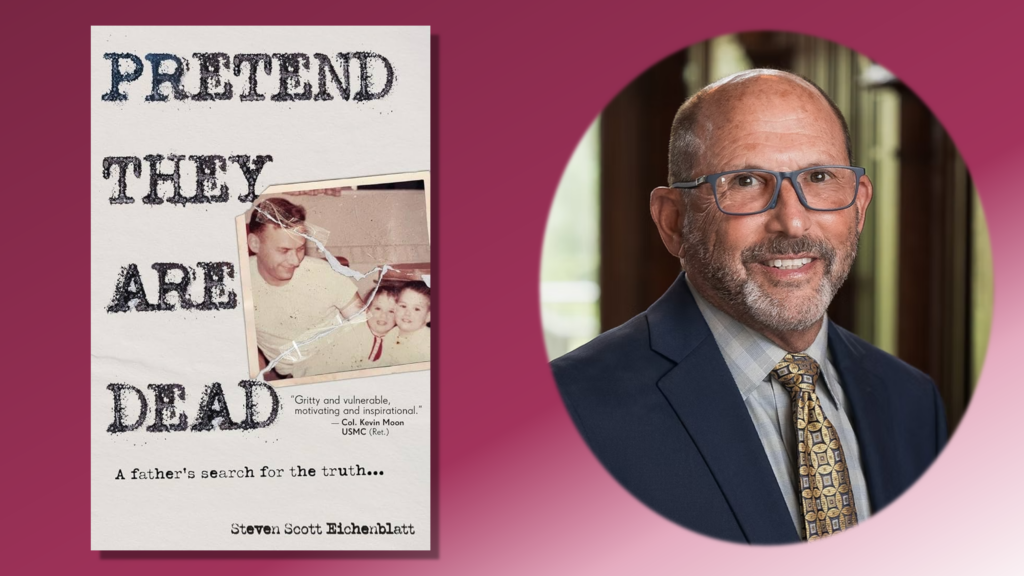
He’s also the author of a riveting memoir called “Pretend They Are Dead” about his experience being abandoned, adopted by an abusive stepfather, and later reuniting with the father who left (spoiler: there’s no fairy tale ending).
We wanted to talk to Steven because he offers something rare in discussions about parental alienation: the perspective of the child, decades later. Not theoretical. Not clinical. But lived.
What does it actually feel like to be that child? What are the long-term effects? How do you survive it and build a life?
And what does Steven see now, as the professional representing children in these situations, that parents don’t understand?
The Brady Bunch From Hell
Abandonment was just the beginning.
Steven and his twin sister went on a weekend trip with their grandparents to Sturbridge Village in Massachusetts – the longest trip the grandparents had ever taken them on, which should have been a clue that something was happening.
When they came back home, a stranger was moving into their lives. With his four kids.
“My mother announces that she has married him,” Steven told us. “And we had met him once or twice before at the most, but just like my father leaving and nobody telling us, nobody told us that she was married. She didn’t tell us that she was getting married.”
Think about that for a moment. You’re seven years old. Your father disappeared without explanation. You go on a weekend trip. You come home to find a complete stranger in your life and being told, “This is your new dad.”
No counseling. No preparation. No gradual transition.
Steven calls it “the Brady Bunch from hell.”
Except unlike the wholesome TV show, this blended family came with “very punitive, corporal punishment rules” that the new father laid out immediately.
“Not being allowed to walk in the front door, not being allowed to sit on the furniture, never ate a meal with my parents – we weren’t allowed to eat at the same time, weren’t allowed in the kitchen,” Steven recounted.
There was emotional damage from “his big mouth and the way he treated us.” There was physical violence with belts and other means. The entire household operated under fear and control.
And then, to complete the erasure of their previous life, Steven and his sister were adopted. Their last name changed, and they were moved from New Jersey all the way down to Florida.
“We were raised to not tell people that we weren’t related,” Steven explained. “Everybody thought we were true, you know, full-blooded brothers and sisters.”
Blood doesn’t determine love, Steven emphasized – he considers his adoptive siblings his real brothers and sisters despite everything. But the forced secrecy, the complete disruption of identity, the lack of any therapeutic support to process what was happening – it all shaped him in ways that would echo throughout his entire life.
Compartmentalizing to Survive: “The Feeling of No Feeling”
How does a seven-year-old child cope with this level of disruption and trauma?
“At the time when you’re a kid, you’re just kind of like, you accept day to day what’s handed to you,” Steven said. “I mean, it’s not like I had a choice.”
His survival strategy was compartmentalization. He learned to push things aside, shove them down, and just… get through each day.
“I became a professional compartmentalizer from an early age,” he explained. “I was really quiet and I was very independent from a young age… I just learned to survive sort of on my own emotionally.”
This is a pattern we see repeatedly in children dealing with high-conflict situations and alienation: they learn to shut down their emotions to cope. They have to. The alternative – feeling everything – would be unbearable.
But compartmentalizing comes with a cost.
“I lost track of my emotions, feelings,” Steven said. “I write in the book, ‘the feeling of no feeling.’ I mean, that is a feeling.”
Think about what that means. A child who learns to not feel ends up becoming an adult who struggles to access emotions. Who can’t connect intimately. Who goes through the motions of relationships without the emotional depth that makes them work.
Steven spoke candidly about how this affected his adult life: “My ex-wives..I got along fine with them because I wasn’t like a cheater or anything like that. They just said Steve’s a really nice guy. He just doesn’t know how to be the intimate, emotional part. I always struggle with it.”
Three marriages. A pattern of being a good person but emotionally unavailable. The direct result of what he learned at age seven: shut it down, compartmentalize, survive.
“I’m better now,” he added. “My wife now is awesome. It’s good.”
But it took decades – and a lot of work – to get there.
The Different Journeys: When Siblings Experience It Differently
Not every child responds to family disruption the same way, even when they’re experiencing the same situation.
Steven’s twin sister had a particularly difficult time because the new family included another girl exactly her age.
“There was another girl who became my sister and they were exactly the same age,” Steven explained. “Girls at that age, I’m no expert, but there was a lot of competition.”
His sister had friends. Suddenly there was a stranger in the house expected to join those friend groups, and the competitive atmosphere became incredibly destructive.
“They shared a room and then they would fight so often, so much that my father built a wall so that they could be separated,” Steven said.
When he sent his sister the book manuscript before publishing to check for accuracy, her response to their experience shocked him: “You weren’t tough enough.”
He had thought he was being honest about how bad things were. She told him he didn’t talk about some of the other things that happened.
“I explained to her, this is my journey, not yours, but her journey was bad in another way,” Steven said.
Everyone carries their own version of the trauma and finds their own way to survive – or doesn’t.
The Search for His Biological Father (No Fairy Tale Ending)
Years later, as an adult, Steven went searching for his biological father and found him.
But when they reunited, it wasn’t at all what you’d hope for.
“There’s no such thing as the 48 hour love story,” Steven said. “Life doesn’t work like that.”
When Steven finally heard his father’s side of the story, it was complicated. There were no clear villains and heroes – just broken people making terrible decisions in impossible situations.
His father had followed psychiatric advice that seems unconscionable now: pretend your children are dead. Walk away, and don’t look back.
And he did.
The reunion didn’t heal everything. It didn’t erase the abandonment or the years of wondering why he wasn’t worth staying for. It didn’t magically restore the relationship that should have been there all along.
But it did provide some understanding and context, even even if it wasn’t the closure Steven might have hoped for.
“I did not want to be a victim,” Steven emphasized. “You are a victim if you’re in a situation where maybe you’re getting abused or whatever it is, but you don’t have to stay a victim and you can’t let that define you.”
What Steven Sees as a Guardian Ad Litem
Now, decades removed from his own childhood trauma, Steven represents children as a guardian ad litem (GAL) – the professional appointed by courts to advocate for children’s best interests in custody disputes.
His lived experience combined with decades of legal practice gives him a unique perspective on what actually helps kids versus what parents think helps.
The Biggest Mistake Parents Make: Letting Anger Show
“Anger is not going to get your kids back faster,” Steven said bluntly. “It’s going to make it far worse.”
This is what he sees constantly: parents who are so consumed with rage at their ex, so focused on the injustice of what’s happening, so determined to make the other parent pay – that they can’t see how their own anger is damaging their case and their children.
“When you have an ex who you hate, hates you, or they’re doing ridiculous things, you have to try to hold your head up as much as you can,” Steven advised. “Because it’s not gonna help you or your kids for you to get angry and for you to engage in that kind of battle.”
He’s seen professionals – doctors, businessmen – who cannot be in the same room with their exes even when their kids are adults. The hatred is so consuming that it outlasts their childhood, the custody battle, everything.
“It just kills the kids,” Steven said. “It really is a brutal toll.”
What GALs Actually Evaluate
When Steven meets with parents in his role as a GAL, he’s not just listening to what they say, but observing everything.
How do they talk about the other parent? Do they badmouth or maintain appropriate boundaries?
How do they present themselves? Are they organized or chaotic? Angry or measured? Focused on the children or on punishing their ex?
Can they separate their legitimate grievances from their parental responsibilities?
The parents who do well understand that the GAL isn’t there to be their friend or to take their side. The GAL is there to figure out what’s best for the child, which often means both parents need to get their act together.
The Critical Importance of Not Bad-Mouthing the Other Parent
This one comes directly from Steven’s lived experience as a child in these situations.
“Don’t criticize the other parent to your children,” he emphasized.
Why? Because children are made up of both parents. When you badmouth their other parent, they internalize it as criticism of themselves.
Steven knows this because he lived it. And now he sees parents making this mistake constantly, thinking they’re “just telling the truth” or “explaining what really happened.”
They’re instead putting their child in an impossible position and damaging the child’s sense of self.
The Long-Term Effects Are Real (But So Is Survival)
Let’s be honest about something: the research on long-term effects of parental alienation is consistent and not encouraging.
Adults who experienced parental alienation as children show:
- Lower self-esteem and self-sufficiency
- Higher rates of substance abuse
- Relationship difficulties
- Insecure attachment
- Lower quality of life
- Higher divorce rates
- Depression and anxiety
- Identity issues
Steven’s life illustrates several of these patterns. Three marriages. Struggles with emotional intimacy. The work required to develop the ability to connect on a deep level.
But here’s what’s also true: Steven has built a successful life. He’s practiced law for 37 years. He’s a father to five children. He’s in a healthy, happy marriage now. He’s written a powerful book. He’s helping other children navigate terrible situations.
The effects are real. They don’t just disappear. But they also don’t have to destroy you.
“I’m better now,” Steven said about his ability to connect emotionally. Not “I’m fixed” or “It’s all behind me.” Better. Improving. Still working on it.
That’s honest, hopeful, and realistic, because it acknowledges both the damage and the possibility of growth.
Practical Advice for Parents Going Through This
Steven’s advice comes from both sides: the child who lived it and the professional who sees it constantly.
1. Get Therapy
You cannot help your children if you’re drowning in your own trauma, anger, and fear. You have to do the work to get yourself to a healthier place.
“Get mental health therapy,” Steven emphasized.
Not just for your kids (though they may need it too): for you.
2. Don’t Rely on the Court To “Just Get This Done”
If you’re looking to family court to fix things quickly, Steven’s advice is stark: “Don’t get your hopes up. It’s going to be a slow process. There’s nothing you can really do to speed it up because there’s so many people in need.”
Find resources elsewhere: your church, temple, the kids’ schools (many offer counseling for children going through divorce), private therapists, support groups.
You can’t wait for the system to save you. You have to save yourself.
3. Exercise
Physical movement helps process trauma. It gives your brain a break from the spiral. It releases stress hormones that build up from constant conflict.
This might sound trivial, but Steven stressed how important exercise is as well as to “get out in nature and move because it’s just a really hard situation.”
4. Have Good Friends
“Make sure you have somebody that you can talk to, especially someone who maybe has been through it before,” Steven advised.
You need people who understand, who won’t judge, and who can listen without offering platitudes or trying to fix everything.
5. Move Beyond the Victim Role
“You don’t have to stay a victim and you can’t let that define you,” Steven said. “You just have to move forward and move past it however it is you can with whatever resources.”
This doesn’t mean denying the injustice. It means not letting that victimization be the only story you tell about yourself.
“No one’s going to help me until I learn how to help myself,” Steven emphasized. “That’s really it.”
What This Means for Your Children
If you’re terrified about the long-term effects of alienation on your children, Steven’s story offers both sobering reality and genuine hope.
The reality: Yes, childhood alienation and family disruption have lasting effects. Steven still struggles with emotional intimacy decades later. The compartmentalization that helped him survive as a child made adult relationships difficult.
The hope: People can build good lives despite terrible childhoods. Steven has a successful career, a good marriage, five children, meaningful work helping other children. The effects don’t disappear, but they also don’t have to define everything.
What makes the difference?
According to Steven’s experience and professional observations:
- At least one healthy parent who doesn’t bad-mouth the other
- Therapeutic support when needed (not waiting for the perfect moment)
- Time to process and heal (it’s not a quick fix)
- The choice to move beyond victimhood when ready
- Building a life focused on meaning and purpose, not just surviving
Your children are watching how you handle this crisis. They’re learning from your example whether recovery is possible, whether adults can be trusted, whether love is conditional.
The best gift you can give them isn’t a perfect childhood – that ship has likely sailed if you’re reading this. The best gift is modeling how to survive terrible things and still build a meaningful life.
Moving Forward: The Power of the Long Game
Steven’s story doesn’t have a neat ending. He hasn’t “overcome” his childhood trauma in the Hollywood sense, and still works on emotional intimacy. He still carries the effects of what happened when he was seven years old.
But he’s also living proof that those effects don’t have to be the entire story.
He found his biological father – not to get a fairy tale reunion, but to understand his own story better. His chosen career lets him help other children in similar situations. He wrote a book that could help adult children of alienation understand their own experiences.
He built a life.
“I did not want to be a victim,” Steven said. “You can’t let that define you.”
This is the long game. Not winning the custody battle (though that matters). Nor proving your ex wrong (though you’d like to). Nor even necessarily reuniting with your children immediately (though you desperately want that).
The long game is: What kind of person are you becoming through this? What are you modeling for your children about resilience, recovery, and refusing to be destroyed by terrible circumstances?
Years from now – maybe decades, like in Steven’s case – your children may look back and see not just what happened to them, but how you handled it. Whether you let bitterness consume you or found a way forward, whether you maintained your integrity even when your ex didn’t, whether you kept the door open for them even when they couldn’t walk through it.
That’s what they’ll remember. It’s what will shape whether they repeat these patterns or break free of them.
Steven broke free. Not perfectly. Not completely. But enough to build a life worth living and to help other children navigate the same impossible situations he survived.
If he can do that after being told his father should “pretend they are dead,” maybe there’s hope for your children too.
Resources
Read Steven’s story in his riveting book, “Pretend They Are Dead,” available on Amazon.
Steven’s website is stevenscotteichenblatt.com/.
Frequently Asked Questions About the Long-Term Effects of Parental Alienation
Q: What are the long-term effects of parental alienation on children?
A: Research shows that adults who experienced parental alienation as children display lower self-esteem, higher rates of substance abuse and divorce, relationship difficulties, insecure attachment, depression, and anxiety. Steven Eichenblatt’s experience illustrates this: he struggled with emotional intimacy through three marriages, describing his emotional state as “the feeling of no feeling” due to compartmentalizing as a survival mechanism. However, long-term effects don’t prevent building a successful life—Steven has a 37-year legal career, is now in a healthy marriage, and helps other children as a guardian ad litem.
Q: How do children cope with parental alienation and family disruption?
A: Many children cope through compartmentalization—shutting down emotions to survive day-to-day. Steven describes becoming a “professional compartmentalizer” at age seven, learning to be quiet and independent, pushing feelings aside because he had no choice. This helps children function during trauma but creates problems in adulthood when emotional connection is necessary for healthy relationships. The survival mechanism that protects them as children often haunts them as adults.
Q: Should I tell my children the truth about why we’re divorcing?
A: No. According to Steven—speaking from both his experience as an alienated child and as a guardian ad litem—children internalize criticism of either parent as criticism of themselves, since they’re made up of both parents. Don’t bad-mouth your ex, even if you’re “just telling the truth.” Support your child’s relationship with their other parent. Courts and guardians ad litem specifically look for this as a sign of healthy parenting. Your children don’t need all the details of adult relationship failures.
Q: What do guardians ad litem actually look for when evaluating parents?
A: According to Steven’s experience representing children, GALs observe everything: How you talk about the other parent (do you bad-mouth them?), how you present yourself (organized or chaotic? angry or measured?), and whether you can separate your legitimate grievances from your parental responsibilities. The biggest mistake parents make is letting anger dominate their interactions—anger won’t get your kids back faster and will damage your case. GALs look for parents who focus on the children’s best interests, not on punishing their ex.
Q: Can children who experience severe parental alienation still have successful adult lives?
A: Yes, though the effects are real and lasting. Steven Eichenblatt experienced extreme abandonment (his father following psychiatric advice to “pretend they are dead”) and adoption by an abusive stepfather. He struggled with three marriages due to emotional intimacy issues stemming from childhood compartmentalization. However, he’s built a successful 37-year legal career, is now in a healthy marriage, has five children, wrote a compelling memoir, and helps other children as a guardian ad litem. The effects don’t disappear, but they don’t have to define your entire life.
Q: How does childhood alienation affect adult relationships?
A: Children who learn to compartmentalize emotions to survive often struggle with emotional intimacy as adults. Steven candidly shared that his ex-wives considered him a “really nice guy” who “just doesn’t know how to be the intimate, emotional part.” The survival mechanism of shutting down feelings serves children well during trauma but creates significant challenges in adult romantic relationships, which require emotional vulnerability and connection. With work (therapy, conscious effort), improvement is possible but it’s an ongoing process.
Q: Should I stay in an unhealthy marriage for my children?
A: No. Steven emphasized that staying in toxic situations teaches children that unhealthy dynamics are normal relationship models. His own parents’ toxic relationship influenced his later choice to enter an unhealthy marriage himself. Children learn what relationships should look like by watching their parents. A healthy separation where both parents eventually thrive models resilience and healthy boundaries—far better than staying in a situation that damages everyone involved.
Q: What should I do if I can’t get mental health support from the state?
A: Don’t rely on the state system alone, according to Steven’s advice. The waiting lists are long and resources are limited. Look for support through churches, temples, kids’ schools (many offer counseling for children going through divorce), private therapists, and community support groups. Exercise and having friends who understand (especially those who’ve been through it) are also essential. You can’t wait for the system to save you—you have to actively seek resources and help yourself.